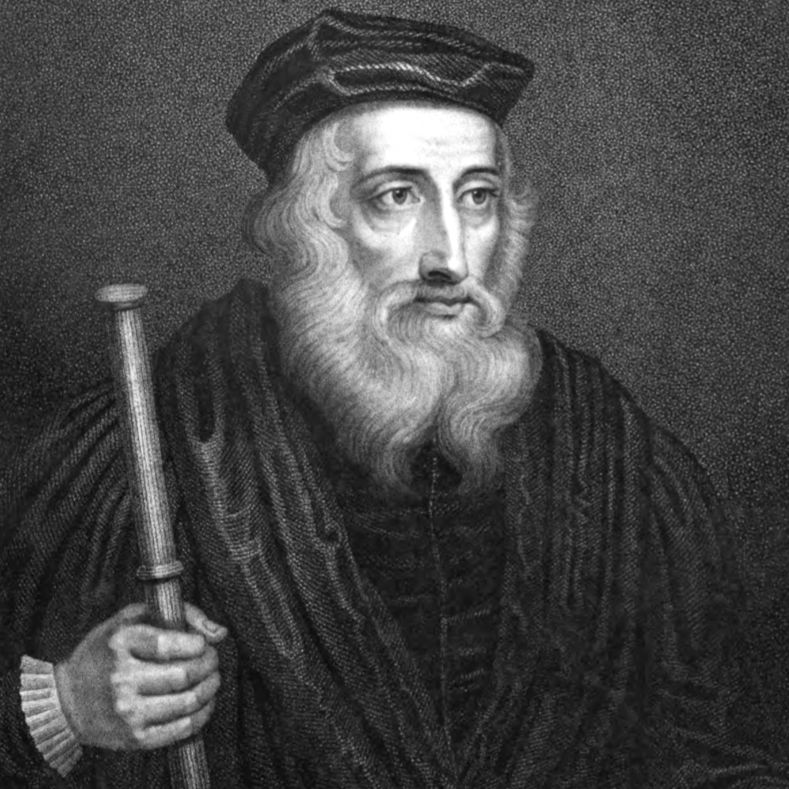
November 10, 2013

Father of Anglicanism: A Concise History of Thomas Cranmer

“Man that is born of woman hath but a short time to live, and is full of misery. He cometh up, and is cut down, like a flower; he fleeth as it were a shadow, and never continueth in one stay.”
(The Book of Common Prayer)

Thomas Cranmer (July 2, 1489 – March 21, 1556) was an English Reformer and also the Archbishop of Canterbury. He was born at Aslacton or Aslockton in Nottinghamshire, England to Thomas Cranmer and his wife, Anne Hatsfield. His parents were minor gentry, and Cranmer received his early education from “a marvellous severe and cruel schoolmaster.”[1]

When Cranmer was fourteen, Anne Hatsfield, already a widow for two years by this point, sent him off to Cambridge to begin his studies as a fellow at Jesus College. It took him eight years to complete his Bachelor of Arts degree. His Master of Arts degree was completed in three years, and he specialized in humanism, especially on the writings of Jacques Lefevre d’Etaples and Erasmus. Upon receiving his Master of Arts degree, Cranmer was elected to a fellowship at Jesus College in 1515.

October 28, 2013

Forerunner of the Reformation: A Concise History of Jan Hus

"God is my witness that I have never taught that of which I have by false witnesses been accused. In the truth of the Gospel which I have written, taught, and preached, I will die today with gladness." (Jan Hus, July 6, 1415)

clip_image002About Jan Hus
Jan Hus (c. 1369 – July 6th, 1415), known in English as John Hus or John Huss, was born in Husinec, Bohemia (in modern-day Czechslovakia). He was not wealthy by any means, and his parents made sure that Hus had enough money to obtain his Bachelor of Divinity (1393) and Masters of Arts (1396) degrees from the University of Prague. He was ordained in 1400/01 as a Bohemian (Czechoslovakian) priest, and he is widely known as a religious thinker, philosopher, and reformer of the Scottish Reformation movement, which was influenced by John Wycliffe’s teachings. He lived a full century before Luther, Calvin, and Zwingli existed.

October 27, 2013

Morning Star of the Reformation: A Concise History of John Wycliffe

"Englishmen learn Christ's law best in English. Moses heard God's law in his own tongue; so did Christ's apostles.” (John Wycliffe)


About John Wycliffe

John Wycliffe (c. early 1320’s, possibly 1324 – December 1384) was an English scholastic philosopher, theologian, lay preacher, translator, reformer and a professor (university teacher) at Oxford in England. He was born in Ipreswell (modern Hipswell), Yorkshire, England about 200 years before the Protestant Reformation movement began, but his beliefs and teachings influenced if not mirrored Luther and Calvin and other reformers during the 16th century.

Reformation Sunday


Luther's Rose
On October 31st, 1517, an audacious and brilliant Augustinian monk marched up to the door of the Castle Church in Wittenberg, Germany, armed with a mallet in his hand and some nails, and affixed a document on the church door titled, “The Ninety-Five Theses on the Power and Efficacy of Indulgences,” or more commonly known as, “The Ninety-Five Theses.” This monk was compelled due to his ardent love for God and the lost souls. This event was what many considered the beginning of the Reformation movement. But this monk, Martin Luther, had no inkling of how profound his action would have on that day.

The Reformation movement turned out to be one of the major defining moment in the history of church comparable to the Trinitarian controversy of the major ecumenical councils during the early church era (especially Nicaea - 325, Constantinople - 381, Ephesus - 431, and Chalcedon - 451), and the ecclesiological conflict of the Great Schism in 1054, when the East (Orthodox) and West (Roman Catholic Church) split up. In fact, the Reformation movement is sometimes considered one of the greatest revivals since the day of Pentecost (see Acts 2)!

Because today is the Sunday closest to the Eve of all Hallows/Saints (October 31st), Protestant churches all over America are commemorating and celebrating the Reformation Sunday. This day has always held a special place in my heart since I grew up as a Lutheran, but it has became even more meaningful since I took my Reformation history class at Beeson Divinity School.

October 16, 2013

Thunderous Silence

“So, when he heard that Lazarus was ill, he stayed two days longer in the place where he was.” (John 11:6)
      In John 11, John the Evangelist introduces us to Lazarus of Bethany. Lazarus was gravely ill and was being attended to by Mary and his sister, Martha. A messenger, bearing an urgent message from the sisters, found Jesus and told him, “Lord, he whom you love is ill” (v. 3). Can you sense the hurrying tone in his voice here? Lazarus, your beloved friend, is gravely sick! Lazarus, your beloved friend, will soon be dead! Come quickly! Yet in spite of this urgency, Jesus issued a mystifying and seemingly dismissive response back to the sisters whom he loved: “This illness does not lead to death. It is for the glory of God, so that the Son of God may be glorified through it” (v. 4).

October 7, 2013

Bonhoeffer on Reading the Scriptures

While collecting information for my doctrinal synthesis paper due by the end of the week, I read something from Dietrich Bonhoeffer's Life Together that privides an accurate reflection of what churches are facing in the modern age.

Dietrich Bonhoeffer completed Life Together in 1939 while teaching at the underground, or "illegal," Finkenwalde seminary during the heyday of Nazism. Here's what Bonhoeffer had to say concerning reading the Scriptures:
We must learn to know the Scriptures again, as the Reformers and our fathers knew them. We must not grudge the time and the work that it takes. We must know the Scriptures first and foremost for the sake of our salvation. But besides this, there are ample reasons that make this requirement exceedingly urgent. How, for example, shall we ever attain certainty and confidence in our personal and church activity if we do not stand on solid Biblical ground? It is not our heart that determines our course, but God's Word. But who in this day has any proper understanding of the need for scriptural proof? How often we hear innumerable arguments "from life" and "from experience" put forward as the basis for most crucial decisions, but the argument of Scripture is missing. And this authority would perhaps point in exactly the opposite direction. It is not surprising, of course, that the person who attempts to cast discredit upon their wisdom should be the one who himself does not seriously read, know, and study the Scriptures. But one who will not learn to handle the Bible for himself is not an evangelical Christian.

September 11, 2013

Why Doth Thou Hidest Thy Face?

On this day twelve years ago, four groups of Muslim terrorists boarded American Airlines Flight 11 and United Airlines Flight 175, American Airlines Flight 77, and United Airlines Flight 93, and, after commandeering each plane, they crashed each plane into the World Trade Center towers in the district of Manhattan, New York City, into the Pentagon of Washington D.C., and in an open field of Shanksville, PA on its way to Washington D.C. As the events of the day unfolded before Americans' eyes on television, fear and horror seized the hearts of men and women of America and the world. People were confronted with the gruesome and heartless face of evil once again. They tried to piece together the pieces that led up to this event and make sense out of this brazen act of terrorism against humanity under the banner of the Islamic God, Allah. They also asked on that day, "Where were you, God, when this happened?"